
GitHub Security Incident: Highlights the Growing Threat of Developer Tool Attacks
A recent GitHub breach shows why businesses must treat cybersecurity as a core part of digital operations, not an afterthought.
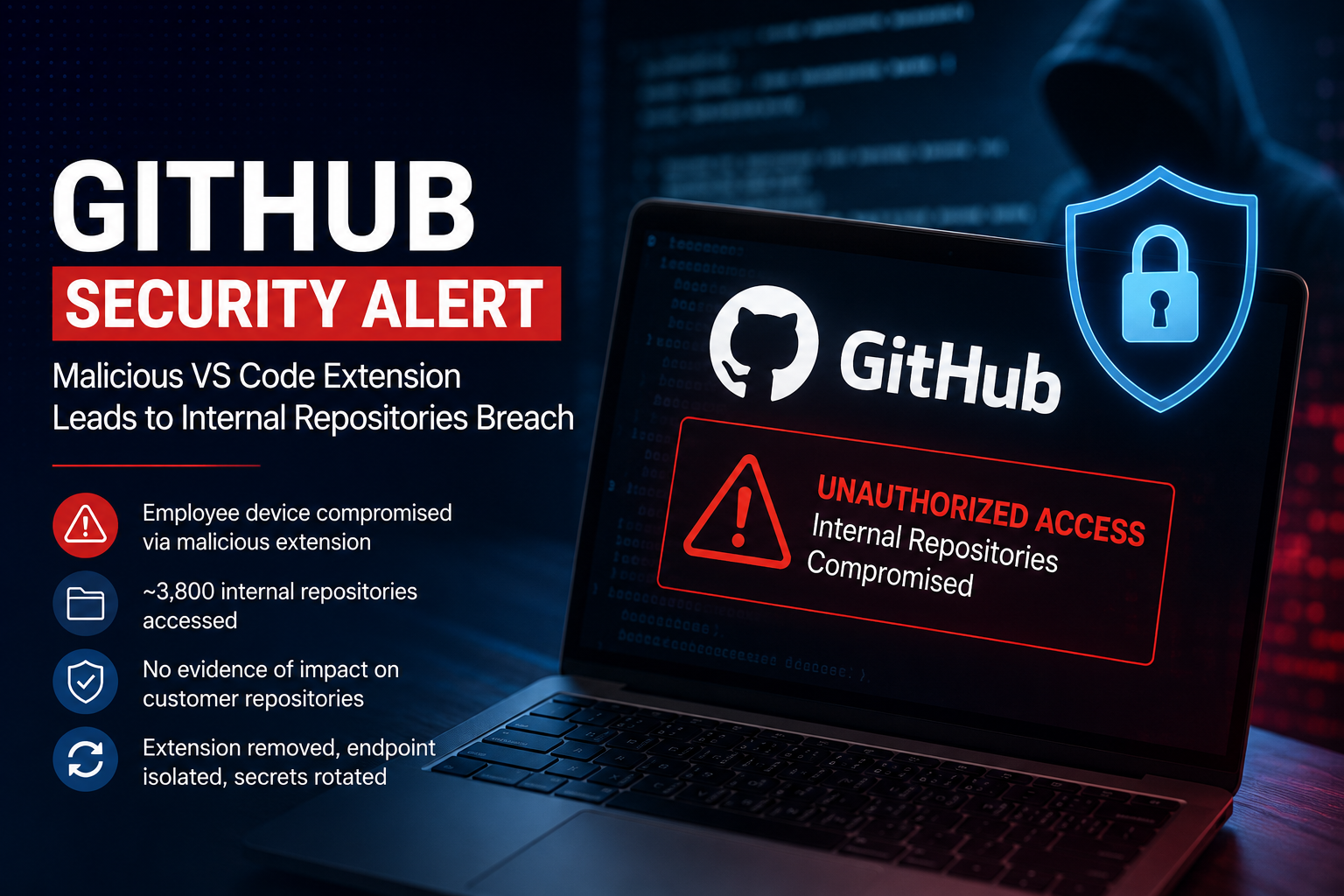
GitHub, one of the world’s largest software development platforms, recently confirmed a security incident involving unauthorized access to some of its internal repositories. According to reports, the incident began after a GitHub employee’s device was compromised through a malicious Visual Studio Code extension. The attackers reportedly accessed and exfiltrated data from approximately 3,800 internal GitHub repositories.
GitHub has stated that the breach was limited to its internal repositories, with no current evidence that customer repositories or customer information outside GitHub’s internal repositories were affected. The company also said it removed the malicious extension, isolated the affected endpoint, rotated secrets, and began incident response immediately.
Why This Matters
This incident is a strong reminder that even trusted technology platforms are constant targets. More importantly, it shows that attackers are no longer only targeting websites, servers, or login pages. They are now targeting the tools developers use every day.
A malicious extension inside a development environment can potentially access source code, configuration files, environment variables, tokens, credentials, and internal workflows. That makes developer workstations and software supply chains critical security areas for every organization.
For businesses, the message is clear: cybersecurity is not just about installing antivirus software or using strong passwords. It is about building secure processes around people, systems, code, infrastructure, and third-party tools.
What Businesses Should Learn
The GitHub incident highlights several important lessons:
- Developer tools must be treated as security-sensitive assets.
Extensions, plugins, packages, and libraries should be reviewed before installation. - Secrets should never be carelessly stored in code repositories.
API keys, database passwords, access tokens, and deployment credentials must be protected and rotated regularly. - Access control matters.
Employees, developers, and vendors should only have the level of access they need to do their work. - Continuous monitoring is necessary.
Organizations need to monitor login activity, repository access, unusual downloads, and suspicious development environment behavior. - Security must be proactive.
Waiting until an incident happens is expensive. Prevention, auditing, and response planning are cheaper than recovery after a breach.
Our Position on Security
At KS Tech, we believe digital transformation must be built on security. As organizations adopt websites, portals, business applications, cloud tools, and automation platforms, security has to be part of the foundation.
Our approach focuses on:
- Secure system design
- Clean and maintainable code
- Access control and permission management
- Secure hosting and server configuration
- Regular backups and recovery planning
- API and database protection
- Monitoring and security reviews
- Protection against common web vulnerabilities
The GitHub incident proves that no organization is too big to be targeted. The right response is not fear, but preparation.
Final Takeaway
The recent GitHub breach is not just a story about one technology company. It is a warning to every business that depends on digital systems.
Your website, business portal, internal software, customer database, and cloud services are valuable assets. Protecting them should be treated as a serious business priority.
Security is not a feature. It is the foundation of trust.